WeveritNYC Building Reports
← Back to news Policy brief · Jul 3, 2026
Policy brief

The Rent Freeze Is Now on Paper: RGB Publishes Official Orders — Here's What to Check on Your Renewal

By Weverit Editorial ·Jul 3, 2026 ·2 min read
Tan-stone prewar apartment buildings with green fire escapes along a street with a speed-bump sign

The historic rent freeze adopted on June 25 is now formally on the books. The Rent Guidelines Board has published the official Orders and Explanatory Statements for apartments, lofts, and hotels covering leases commencing October 1, 2026 through September 30, 2027 — the documents that turn a vote into an enforceable rule. They're available on the board's site, and they matter for one practical reason: your renewal lease has to match them.

What the Order locks in

  • 0% increase on both one-year and two-year renewal leases for rent-stabilized apartments — the first two-year freeze in the board's history.
  • The window: renewal leases beginning October 1, 2026 through September 30, 2027. A renewal that starts before October 1 falls under the previous guideline, not the freeze — timing is everything.
  • The board votes again next year; this freeze covers one cycle, not forever.

What to check when your renewal arrives

Renewal offers for October leases start arriving this summer (owners must offer renewals in a window ahead of expiration). When yours comes:

  1. Check the lease start date. On or after October 1, 2026 → the guideline is 0% on either term. Before October 1 → last year's guideline applies to that renewal.
  2. Check the rent math. For a lease in the freeze window, the legal renewal rent should equal your current legal rent. An increase on a covered renewal isn't a clerical difference of opinion — it's a violation of the published Order, and you can challenge it (start by pointing the owner to the Order; escalate to HCR if needed).
  3. Confirm you're actually stabilized. The freeze covers rent-stabilized units only — roughly one million apartments. If you're not sure your unit is one of them, check before you assume either way; leases don't always advertise it.
  4. Two-year option math changed. Historically the two-year lease traded certainty for a higher rate. This cycle, both terms are 0% — which makes the two-year renewal unusually attractive: the same freeze, locked for longer. (Next year's board sets the next number; a two-year lease signed in this window carries its 0% through.)

The publication of the Orders also closes the debate about whether the June vote might shift before taking effect: it's adopted, documented, and operative on schedule. For the wider context — the vote itself, the affordability data behind it, and the permanent freeze programs for seniors and tenants with disabilities — our rent-stabilization resource center collects the full picture, starting with our breakdown of the June 25 vote.

Weverit provides independent, tenant-side research from New York City public records. Order details per the NYC Rent Guidelines Board's published 2026 guidelines.
Run a check on your own building Every Weverit report compiles NYC public records in seconds. Check a building →
Latest news

Latest news from Weverit.

Tenant guides, law changes, and neighborhood reports — written in plain English, sourced from the same public records that power Weverit building reports.

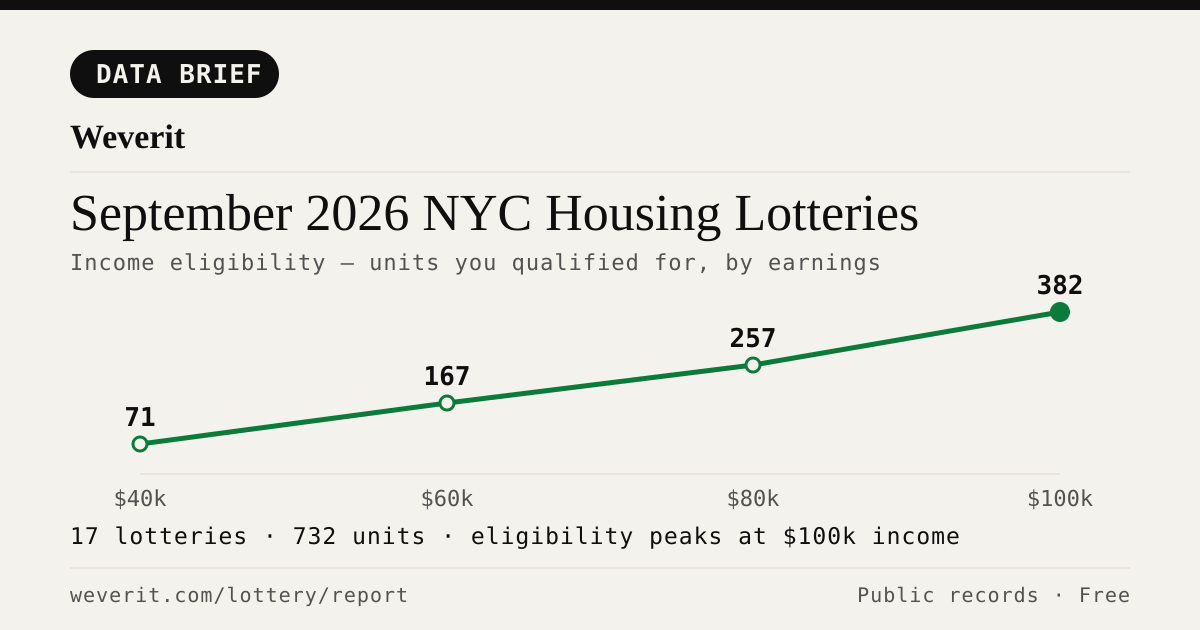
Income-eligibility curve for September 2026 NYC housing lotteries
DATA BRIEF·Oct 1, 2026

September 2026 NYC Housing Lotteries: Who Qualifies

17 lotteries, 732 affordable units — who qualifies by income, plus rents, AMI bands and application windows, from public records.

Read article →
HOUSING LOTTERY·Sep 27, 2026

Your Housing Connect Log Number Came Up. Here's What to Check Before You Sign.

A Housing Connect listing tells you the rent and the apartment size. It does not tell you how the building is run. Seven public records to check before you sign — and what a clean record does not mean.

Read article →
New york
MARKET-BRIEF·Sep 19, 2026

NYC's Smallest Apartment Buildings Have Four Times More Dangerous Violations Per Apartment Than Its Largest

We measured open HPD violations per apartment across NYC buildings. Buildings with six units or fewer carry four times the immediately-hazardous violations per apartment that buildings of 38+ units do — and they are the least likely to draw attention.

Read article →
TENANT GUIDE·Sep 6, 2026

Pets in your NYC apartment: the no-pet clause, the waiver rule, and what your landlord can actually enforce

NYC's Pet Law gives tenants who openly keep a pet for 3 months legal protection against no-pet clauses. Here's exactly how it works.

Read article →
RENTER GUIDE·Sep 6, 2026

How to find out who owns your NYC apartment building

Most NYC buildings are owned through LLCs. Here's how to trace the owner through ACRIS, HPD registration, and DOF records — step by step.

Read article →
RENTER GUIDE·Sep 6, 2026

How to check a NYC building's complaint history — and what it actually means

Complaints and violations are not the same thing. Here's how to read HPD and DOB records — and what the patterns actually tell you about a building.

Read article →
RENTER GUIDE·Sep 6, 2026

Certificate of Occupancy in NYC: what it is and why it matters before you sign

A C of O defines how a building can legally be used and how many units are permitted. Here's what to check — and what missing or mismatched records mean for tenants.

Read article →
Latest reports

Recent building reports from Weverit.

The most recently generated reports from real NYC addresses — independent due-diligence on buildings tenants are actually checking.