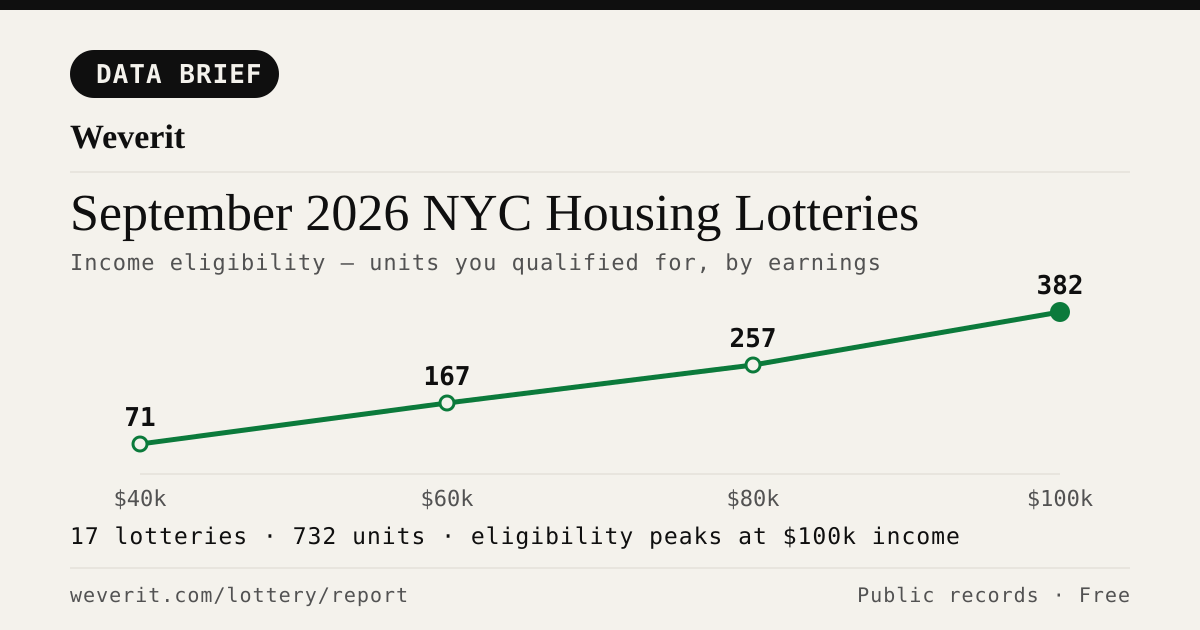
See the NYC housing lotteries open right now →
If you're trying to find affordable housing in New York City, almost every path runs through NYC Housing Connect — the city's lottery portal. The process has a lot of moving parts: building a profile, income ranges, asset limits, application steps, a log number that decides your place in line, and a document review that quietly decides most outcomes. This guide walks the whole process start to finish, and links to an in-depth guide for each piece.
In this guide
- What NYC Housing Connect is
- Step 1: Build your profile
- Step 2: Check if you qualify by income
- Step 3: Check the asset limit too
- Step 4: Apply before the deadline
- Step 5: Get your log number
- Step 6: Document review and interview
- Check the building before you commit
- What Housing Connect is not
- Common reasons applications get rejected
- How the pieces fit together
- Frequently asked questions
- The full NYC Housing Connect guide series
What NYC Housing Connect is
NYC Housing Connect, run by the city's Department of Housing Preservation and Development (HPD) and Housing Development Corporation (HDC), is a single portal where you build one profile and apply to affordable housing lotteries across all five boroughs. The mental model is exactly what people call it — a lottery: you apply, applications are drawn in random order, and units are offered down that order until they run out.
The affordable units come from several sources, but you don't need to track the programs — they all flow through the same application. Broadly, listings include newly built units created when developers get zoning bonuses or tax incentives in exchange for setting aside regulated-rent apartments; rehabilitated or newly affordable units in existing buildings; and units in HUD, Section 8, senior, or supportive housing developments.
Step 1: Build your profile
You create a single Housing Connect profile that holds your household information — who lives with you, your income, and your assets. This profile is reused for every lottery you apply to, so getting it complete and accurate once saves work on every application.
Two details trip people up. Your household size includes everyone who will live in the apartment. Your household income includes essentially all income — salary, hourly wages, tips, Social Security, child support, even interest from savings and gains from investments — not just what's on your W-2.
Step 2: Check if you qualify by income
Every unit sets an income range — a minimum and a maximum — based on your household size and an AMI (Area Median Income) band. Units span from extremely low income (around 30% AMI) up to middle income (as high as 165% AMI). You qualify for a unit only when your household income falls inside its range and your household size fits. (The minimum may not apply if you have a Section 8 voucher.)
The most common reason people apply to lotteries they can't win is misreading the income range. Get it right: NYC Housing Lottery Income Requirements and AMI Bands.
Step 3: Check the asset limit too
Income isn't the only test. There's a separate asset limit — too much in savings or investments can disqualify you even with a qualifying income. Retirement accounts are usually exempt; owning residential property within 100 miles of NYC is usually disqualifying. This catches applicants by surprise at the document-review stage.
Understand the second test: Asset Limits for the NYC Housing Lottery, Explained.
Step 4: Apply before the deadline
Once you've found lotteries you qualify for, you apply through Housing Connect. Lotteries stay open for several weeks, and it doesn't matter when you apply within that window — applying on day one gives you no advantage over the last day, because selection is random, not first-come. Submit one application per development (applying twice to the same one can disqualify you), and make sure your profile is complete.
Step-by-step: How to Apply to the NYC Housing Connect Lottery.
Step 5: Get your log number
A few weeks after the deadline, every complete application gets a randomly assigned log number — your position in the queue for that building. Applications are reviewed lowest-number first, so a low number means you're reached sooner. Only complete applications get a log number, so an incomplete profile means you're effectively not in the draw.
You can't control the draw, but you can control whether you get a usable number (complete profile), how many draws you enter (apply widely), and whether you survive review (clean documents). The number that decides everything: What Is a Log Number on NYC Housing Connect?.
Step 6: Document review and interview
If your log number is reached, the marketing agent contacts you to verify your eligibility. You'll submit documents — income (pay stubs, tax returns), ID, proof of residency, household composition — and likely attend an interview. This is where applications are won or lost: a low number gets you reached, but clean, complete, on-time documents are what get you the apartment. The whole process, from deadline to lease signing, commonly takes several months to over a year.
Check the building before you commit
Winning a lottery is the start of a multi-year commitment in a real building with a real landlord. A polished listing can hide years of open HPD violations, heat complaints, or a landlord with a citywide pattern of neglect. Before you accept a unit, check the building's public record — Weverit pulls open violations, complaint history, and ownership records from official NYC data, free.
What Housing Connect is not
Housing Connect is not Mitchell-Lama — that's a separate, older affordable housing program with different rules and waiting lists. It's also not Section 8 itself, though Section 8 voucher holders can use their vouchers on Housing Connect units. And winning a lottery is not instant: it's a months-long verification process, not a move-in-tomorrow prize.
Common reasons applications get rejected
Most rejections aren't bad luck — they're avoidable. According to Housing Connect, the most common reasons are:
- Not meeting the income or household eligibility — applying to a unit where your income is above the maximum or below the minimum, or your household size doesn't fit.
- Submitting more than one application to the same development — duplicates get disqualified, or you're assigned the least advantageous log number. Don't apply online and by mail to the same lottery.
- Incomplete information — a profile or application missing required details.
- Undisclosed assets or income found at the interview — exaggerating or omitting figures to fit a range. Document review catches it, and it's an automatic disqualification.
- Missing documents, interviews, or deadlines — once your number is reached, missed emails or late paperwork mean automatic disqualification. Check your spam folder and respond fast.
- Owning residential property within 100 miles of NYC — disqualifying regardless of income.
If you are rejected and believe it was an error, you generally have two weeks (ten business days) to appeal in writing to the developer. (Full guide: the most common rejection reasons and how to appeal.)
How the pieces fit together
The lottery isn't one decision — it's a sequence: build a complete profile, confirm you fit the income range, confirm you're under the asset limit, apply to everything you qualify for, get your log number, and verify cleanly when reached. Applicants who treat it as a disciplined process — complete profile, wide application, flawless documents — consistently outperform those who apply to a single lottery and hope.
Frequently asked questions
What is NYC Housing Connect? NYC Housing Connect is the city's official portal for affordable-housing lotteries, run by the Department of Housing Preservation and Development (HPD) and the Housing Development Corporation (HDC). You build one profile and use it to apply to lotteries across all five boroughs. The mental model is a lottery: you apply, applications are drawn in random order, and units are offered down that order until they run out. The listings come from several sources — newly built units created when developers get zoning bonuses or tax incentives to set aside regulated-rent apartments, rehabilitated or newly affordable units in existing buildings, and units in HUD, Section 8, senior, or supportive housing — but they all flow through the same application.
Who qualifies for the NYC housing lottery? Eligibility is set per listing, not by a single citywide rule. Every unit sets an income range — a minimum and a maximum — based on your household size and an AMI (Area Median Income) band, and units span from extremely low income (around 30% AMI) up to middle income (as high as 165% AMI). You qualify for a specific unit only when your household income falls inside its range and your household size fits; household size includes everyone who will live in the apartment. There's also a separate asset limit, so too much in savings or investments can disqualify you even with a qualifying income. If you have a Section 8 voucher, the minimum income requirement may not apply.
Does it matter when I apply during the lottery window? No. Lotteries stay open for several weeks, and it doesn't matter when you apply within that window — applying on day one gives you no advantage over the last day, because selection is random, not first-come. What does matter is that your application is complete and that you submit only one application per development; applying twice to the same one can disqualify you or leave you with the least advantageous log number. So use the window to make your profile accurate and complete rather than to rush — just don't miss the deadline, which is the one hard cutoff that actually removes you from the draw.
How do I improve my odds? You can't control the random draw, but three levers are entirely yours. First, make sure you get a usable log number by keeping your profile complete — only complete applications are assigned a log number, so an incomplete profile means you're effectively not in the draw. Second, enter as many draws as you legitimately can by applying to every lottery you genuinely qualify for; each one is an independent draw. Third, survive the document review by having clean, complete, on-time paperwork ready — a low number gets you reached, but clean documents are what actually get you the apartment. Complete profile, wide application, flawless documents: those are the levers you control.
Is Housing Connect the same as Mitchell-Lama? No. Mitchell-Lama is a separate, older affordable-housing program with different rules and its own waiting lists — it isn't part of the Housing Connect lottery, which is run by HPD and HDC. Housing Connect is also not Section 8 itself, although Section 8 voucher holders can use their vouchers on Housing Connect units. One more distinction worth keeping straight: winning a Housing Connect lottery is not instant. It's a months-long verification process — a document review and an interview before you sign a lease — not a move-in-tomorrow prize.
How long does it take? Commonly several months to over a year, measured from the application deadline to signing a lease. The timeline has a few stages: a few weeks after the deadline, every complete application is assigned a log number; applications are then reviewed lowest-number first, so how soon you're reached depends on your number. If your number is reached, the marketing agent contacts you to verify eligibility through a document review and likely an interview before a lease is offered. Because each stage depends on the one before it, the full process routinely stretches across many months rather than weeks.
The full NYC Housing Connect guide series
Sources: NYC Housing Connect (housingconnect.nyc.gov); NYC HPD; NYC HDC; HUD AMI guidance. Program details and AMI figures update over time — confirm current terms on the official listing. This article is for informational purposes only and is not legal advice.