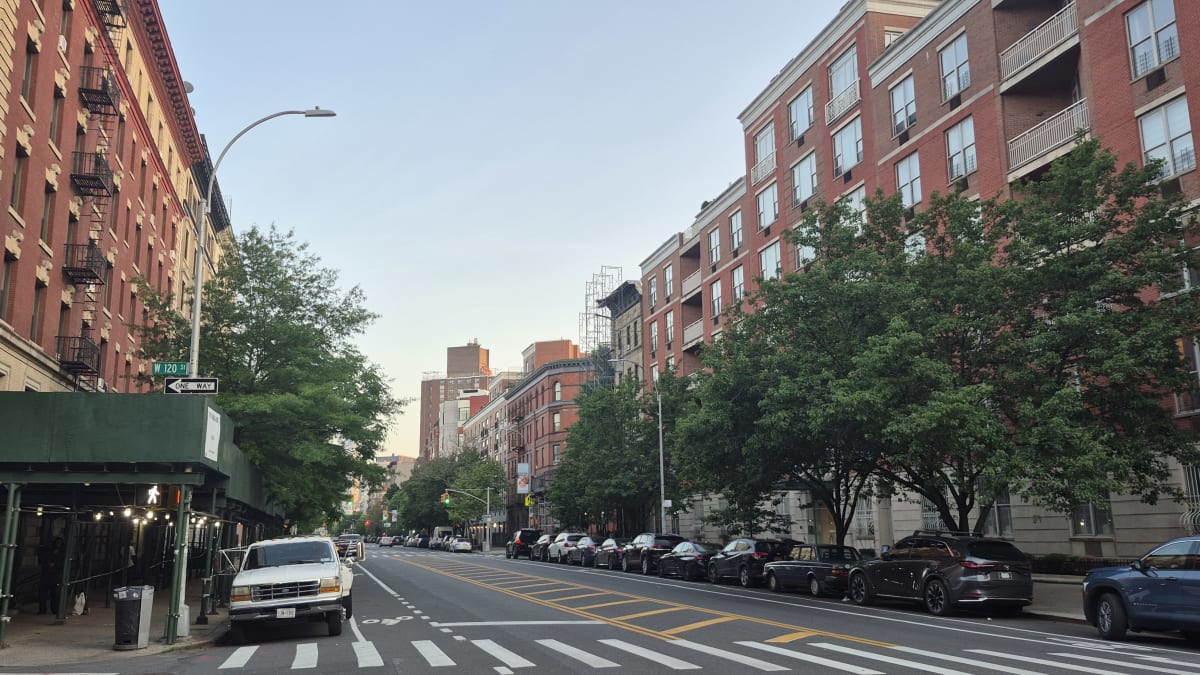
Feryal Nawaz, Carla Orlandi, and Parisa share a three-bedroom apartment on Second Avenue in the East Village. In 2026, their landlord declined to renew their lease, citing demolition plans. The roommates, all 27 years old, had decorated for each other's birthdays, hosted movie nights, and kept deflated air mattresses for guests. The lease non-renewal was the legal mechanism the landlord used to seek their departure.
The roommates declined to leave. They are now contesting the non-renewal in Housing Court.
According to coverage in THE CITY's May 13, 2026 reporting, their case is one of several test cases now active in NYC Housing Court. The cases will determine a specific legal question: under New York State's Good Cause eviction law, does "demolition" require literal destruction of the building, or does extensive renovation work qualify?
The answer will affect thousands of NYC tenants. Five apartments in an Upper West Side building at 303 West 74th Street are in similar circumstances. Other cases are pending across the city. Courts have not yet determined whether the landlords' interpretation of the statute is valid.
What Good Cause requires
The Good Cause eviction law, passed by the New York State Legislature in 2024 and effective for NYC, requires landlords of certain market-rate apartments to demonstrate "good cause" to terminate a tenancy or refuse a lease renewal. The statute lists specific grounds that constitute good cause: nonpayment of rent, breach of lease, nuisance behavior, and several others.
The statute also lists exemptions to the law's protections. Buildings being demolished or substantially renovated for purposes other than rental housing are exempt. So are owner-occupied small buildings, high-rent units exceeding statutory thresholds, and several other categories.
The "demolition" exemption is the one being tested in the current Housing Court cases. The statutory language allows lease non-renewal when a building is "being demolished or substantially altered." What counts as demolition versus renovation — and what counts as "substantial alteration" — has not been precisely defined by case law.
The specific dispute
In the East Village case, the landlord cited demolition plans as the reason for non-renewal. The roommates' lawyer has argued in court filings that the landlord's actual plans constitute renovation rather than demolition, and that the building is not being torn down.
In the Upper West Side case (303 West 74th Street), tenants in five apartments are contesting a similar non-renewal. The building is a Renaissance Revival-style townhouse located in a historic district. The tenants' lawyer, James Fishman, has pointed out in court filings that demolition of the building would require approval from the city Landmarks Preservation Commission — a process not yet initiated.
What the landlord side argues
Landlord-side attorneys have argued that the statute's "substantially altered" language intentionally encompasses major renovation projects, not only literal demolition. The drafting choice, in this view, reflects a legislative judgment that some renovation projects are practically impossible to complete with tenants remaining in place.
Sherwin Belkin, an attorney representing landlords in other matters, told THE CITY that to use the demolition exemption successfully, landlords would need to pursue "at least a gut renovation. You're leaving the four walls of the apartment and maybe some of the partitions, but I wouldn't leave in much more. The more you leave, the more there's issues about whether or not you're demolishing." Belkin's framing reflects the legal advice some landlord-side practitioners are providing.
The landlord-side argument acknowledges that a narrow interpretation of "demolition" — requiring literal building destruction — would render the exemption nearly unusable. Substantial renovation work, in this reading, requires the same temporary vacancy that demolition does, and the statute should be interpreted to allow it.
What the tenant side argues
The tenants' lawyers argue that "demolition" in the statute means the complete removal of the building or unit — not extensive renovation work — and that allowing extensive renovation to qualify would create a significant loophole in Good Cause protections. The "substantially altered" qualifier, in this reading, applies to major structural changes affecting the building as a whole, not to apartment-level renovations that could plausibly be performed while tenants remain in place during sequenced work.
The tenants' arguments are supported in part by the broader purpose of the Good Cause statute, which was designed to provide meaningful renewal protections for tenants in market-rate apartments. A demolition exemption broad enough to cover routine renovation would, the tenant-side argument runs, defeat that purpose.
What the cases will decide
NYC Housing Court is now in the process of hearing these cases and others like them. According to coverage, housing lawyers do not expect courts to issue a final determination on what "demolish" means in this context for at least a year, as cases work through trial-level decisions and appeals.
The implications are large for both sides. If extensive renovation qualifies as demolition under the statute, the Good Cause exemption could be used in cases where landlords seek to remove tenants for renovation projects. The 2019 reforms restricted vacancy decontrol for rent-stabilized units; the Good Cause demolition exemption could become a parallel mechanism in market-rate apartments.
If, on the other hand, courts interpret "demolition" narrowly — requiring actual building demolition rather than renovation — the exemption would apply only in rare circumstances, and the Good Cause framework's tenant renewal protections would be substantially preserved.
The same dispute in Housing Court may end up with different outcomes in different cases, given that different judges in different courthouses may interpret the statute differently. Appellate review will likely be required before NYC arrives at a consistent legal answer.
How this connects to other recent litigation
The demolition exemption dispute is one of several active NYC housing law cases that will shape the legal landscape over the next 12 to 24 months.
In People v. Commons West, LLC, the New York State Supreme Court Appellate Division Third Department ruled on March 5, 2026 that the state's source-of-income discrimination protection is unconstitutional on its face insofar as it compels landlord participation in Section 8. The Attorney General has appealed to the Court of Appeals.
In Lulgjuraj v. New York, the Institute for Justice filed a federal lawsuit in December 2025 challenging the application of the Rent Stabilization Law to vacant apartments. The case targets a narrower constitutional theory than prior challenges and will work through federal court over the coming year.
Cases interpreting the Good Cause demolition exemption add a third layer: a state-law question about the meaning of statutory exemptions, working through NYC's housing court system rather than federal court.
Each case operates under its own legal framework. Together, they will shape what NYC's housing regulation system looks like by 2027 and beyond.
What tenants facing similar non-renewals can do
For tenants who receive a non-renewal notice citing demolition, several practical steps apply.
Request the non-renewal notice in writing. The landlord must provide written notice of non-renewal. Verbal statements are insufficient.
Verify the building's pending permits. The NYC Department of Buildings (DOB) publishes permit applications and approvals through its BIS portal. Demolition permits are searchable by address and BIN. If no demolition permit has been filed, the landlord's stated grounds may be questioned in court.
Check Landmarks Preservation Commission requirements. Buildings in historic districts (including parts of the East Village and Upper West Side) require LPC approval for demolition or substantial alteration. If no LPC application has been filed, the demolition claim faces an additional procedural barrier.
Contact a tenant legal services organization. Legal Aid Society, Legal Services NYC, Met Council on Housing, and other organizations maintain housing legal services intake channels. Many cases involving Good Cause non-renewals can be contested with legal representation.
Document the apartment and lease history. Photographs, prior lease copies, and records of rent payments support any contest of a non-renewal. The longer the tenancy, the stronger the position.
The decision whether to stay and contest a non-renewal versus accepting it depends on each tenant's circumstances, the specific facts of the landlord's claim, and the strength of legal support available. The current Housing Court cases will, over the next year, provide more concrete guidance on what works.
What landlords planning renovation projects can do
For owners considering major renovation projects on Good Cause-covered buildings, the same litigation provides parallel guidance.
The strongest defensible cases for invoking the demolition exemption — based on landlord-side legal commentary — appear to be those involving gut renovations approaching the level of building reconstruction. Smaller-scale renovations that could plausibly be completed with tenants temporarily relocated or sequenced through the building face higher legal risk.
Filing demolition permits, obtaining LPC approval where required, and documenting the scope of work all create stronger procedural records that may support the use of the exemption. Conversely, citing demolition without corresponding permits, designs, or scope documentation creates weaker procedural records.
Until appellate courts resolve the statutory interpretation question, owners proceeding in this area are operating in a partially defined legal environment.
What is unresolved
The next significant data points will be specific court decisions on the cases currently pending. The East Village and Upper West Side cases are scheduled to proceed through Housing Court over the coming months. Other cases will be filed.
Each court decision will be a specific fact pattern, not a general rule. A consistent legal answer will likely require either an appellate decision establishing a precedent, or a series of consistent trial-court rulings that effectively settles the interpretation. The first appellate decision in this area is unlikely to arrive before late 2026 or 2027.
Sources: THE CITY, "To Evict Good Cause Tenants, Landlords Now Claim 'Demolition.' Is It Valid?" (May 13, 2026); New York State Good Cause eviction law (2024); New York City Department of Buildings BIS portal; NYC Landmarks Preservation Commission public guidance; statements from James Fishman (counsel for 303 West 74th Street tenants) and Sherwin Belkin (landlord-side practitioner) as quoted in the cited coverage; tenant statements from Feryal Nawaz, Carla Orlandi, and Parisa as quoted in THE CITY coverage; New York State Supreme Court, Appellate Division Third Department decision in People v. Commons West, LLC (March 5, 2026); Institute for Justice federal court filing in Lulgjuraj v. New York (December 2025); New York City Legal Aid Society, Legal Services NYC, Met Council on Housing public intake guidance.





